For owners who have heard generic intake
Penny starts with your trade’s questions and learns your shop’s answers.
A caller says the unit runs but blows warm. Penny’s HVAC reference helps her ask the next intake question; your website tells her whether you service that equipment in the caller’s town. Trade knowledge and your business details work together.
Included on All plans
14 days of Pro included. No credit card.
01
Read the reference behind a trade’s intake questions
A pack covers the equipment, the words callers use, and the details your team needs on a service request. Open your trade to read its topics beside a line from the call. Compare it with what you would teach someone taking their first shift at your desk.
The pack supports reception work: recognize the caller’s terms, collect useful details, and follow the trade’s safety boundaries. Diagnosis, inspections, and professional judgments stay with the person doing the work.
HVAC
- Split systems, package units, heat pumps, mini-splits, furnaces, boilers, and air handlers, and which one a caller means by “the box next to the house.”
- SEER2, AFUE, HSPF2, tonnage, and BTU, and what a caller means when they say Freon.
- Repair vocabulary for intake, including capacitor, flame sensor, and control board; symptoms such as runs but blows warm, short-cycling, ice on the line set, water at the base of the air handler, a furnace that lights and drops out.
- Tune-ups, maintenance agreements, plan tiers, priority scheduling, and repair discounts.
- Repair-versus-replace signals, the federal tax credits, and utility rebates, noted for the tech rather than decided on the phone.
- The R-22 phase-out, the R-410A phasedown, A2L refrigerants, and why Section 608 means no one gets a top-off over the phone.
- Gas smell, CO alarm, and cracked-heat-exchanger escalation, in the order the trade runs it.
- Indoor air quality: MERV ratings, whole-home humidifiers and dehumidifiers, UV lights, and the 30-to-90-day filter rule.
- Carrier, Trane, Lennox, Rheem, Ruud, Goodman, and Amana, so a brand name on the call goes on the ticket.
From the callRead the HVAC example“I’ll note that it lights and then drops out. The technician can review that starting sequence before the visit. Can I get the service address?”
Property management
- Caller types and routing: tenants, prospects, owners, vendors, and board members, with verification of the leaseholder before any balance, lease date, or access code comes up.
- Three-tier maintenance priority: what wakes a vendor tonight, what gets a same-day work order, and what waits in the morning queue.
- Fair housing: the federal protected classes, state and local extensions, steering and familial status, and why a receptionist says nothing about who lives in a building.
- Pets versus assistance animals: pet rent, pet deposits, breed limits, and the ADA service-animal and FHA emotional-support-animal distinction she recognizes and routes.
- Leasing and applications: the documents typically required, application fees, and what a receptionist may say about screening, which is nothing about outcomes.
- Rent and payments: portal instructions, ACH timelines, grace periods, late and NSF fees as you have written them, and balance requests that go to the desk.
- Security deposits and move-out: intent to vacate in writing, normal wear and tear versus damage, and dispositions that belong to licensed staff.
- Access, keys, and showings: right-of-entry notice, after-hours lockouts, re-keying between tenants, and self-showing codes that are never read out without verification.
- Owner relations: management agreements, trust accounting, statements and draws, recognized and routed, never discussed on the phone.
- Habitability: heating minimums, repair timelines, and the disclosures on lead, smoke and CO detectors, mold, and bed bugs that she knows exist and leaves to the manager.
From the callRead the property management example“Which kitchen cabinet is it? Should maintenance call before coming, and is there anything they need to know about access?”
Plumbing
- Water supply versus drain-waste-vent, and which system a caller means by “the pipe burst,” “something is gurgling,” or “sewage is coming up.”
- Water heaters: tank, tankless, and heat-pump; gas, electric, and the symptom map for no hot water, rusty water, a leaking base, noises, and a T&P valve that discharges.
- Drains and sewers: snaking versus hydro jetting, camera inspection, root intrusion in the lateral, and trenchless lining or pipe bursting versus open trench.
- Repipe triggers and pipe materials: galvanized steel, polybutylene, copper, PEX, CPVC, and cast iron.
- Lay-to-trade symptom mapping: the curvy pipe under the sink is a P-trap, water at the toilet base is a wax ring or flange, the little valve behind the toilet is an angle stop, banging pipes are water hammer.
- Emergency triage: gas smell means leave and call 911 or the utility from outside; CO means fresh air, 911, and medical attention for symptoms. Uncontrolled water, sewage, and frozen pipes each have their own rule.
- Where the plumber stops and the next trade starts: restoration for drying and drywall, HVAC for the furnace, a septic company for the tank and drain field, the utility for the curb stop.
- Pricing structure without numbers: flat-rate versus hourly, the service-call or diagnostic fee, after-hours premiums, and a written price before work starts.
- Licensing, permits, and code as recognize-and-escalate: license tiers, gas-fitter and backflow credentials, what a water heater permit triggers, IPC versus UPC.
- Warranty layers kept separate: manufacturer parts, the shop’s workmanship, and homeowners insurance, with the sudden-and-accidental standard noted for the office, never decided on the phone.
From the callRead the plumbing example“I’ll note a drip from the spout with the handle off, and no water underneath. The plumber will check the fixture before recommending parts or quoting the repair.”
Legal
- Practice areas and what a caller means by each: family, employment, personal injury, estate planning, criminal defense, immigration, real estate, and business matters.
- Intake vocabulary: potential new client, matter, retainer, consult fee, engagement letter, contingency, flat fee, and hourly billing.
- Why the conflict check runs before the consult, and which names it needs: the other party, related companies, spouses, and prior counsel.
- Deadline signals on a first call: served papers, a court date, a demand letter with a response date, a severance agreement with a review window, and a limitation period the caller mentions.
- The difference between a current client with a case update and a potential client, and why the first goes through while the second gets intake.
- Calls the firm does not take: matters outside its practice areas, callers who already have counsel, and the opposing party, with the referral or bar-association line she offers instead.
- Court-adjacent callers: process servers, clerks, opposing counsel, and the press, and the route each one takes under your rules.
- Consult formats, in-office, phone, and video, and the practice areas where the attorney wants documents at the first meeting.
- Ethics boundaries on the phone: no legal advice, no case evaluation, no fee outside the configured schedule, and no promise of an outcome.
From the callRead the legal example“A 21-day review period is the kind of deadline the attorney will want in front of her, so I’m noting the day you received the packet and flagging the 21-day window on your intake. Which day was that?”
Dental
- Hygiene columns and doctor columns, block scheduling, and the practice’s own lengths and provider rules for new-patient exams and recalls.
- Prophy, periodontal maintenance, bitewings, and full-mouth series as desk vocabulary; the clinical team decides care and the desk verifies benefit limits.
- PPO in-network and out-of-network, annual maximums, waiting periods, missing-tooth clauses, and predeterminations, recognized and routed to the desk, never decided on the phone.
- Delta Dental, MetLife, Cigna, Aetna, Guardian, and state Medicaid plans, so the carrier lands on the appointment the way the desk writes it.
- The procedures callers ask for by name: crowns, root canals, extractions, implants, clear aligners, whitening, dentures, sealants, and fluoride for children.
- Post-extraction calls: the procedure date and reported bleeding, swelling, or worsening pain, passed to the treating or on-call dentist without labeling the cause.
- Referral patterns to the endodontist, the oral surgeon, the periodontist, and the orthodontist, and what those offices need from the desk.
- Avulsion and other dental injuries: record whether the caller believes the tooth is permanent or primary, then follow the practice’s immediate dentist-contact route.
- Emergency warning descriptions, including trouble breathing, serious head or jaw injury, and uncontrolled bleeding, routed under the practice’s approved emergency script.
From the callRead the dental example“I’ll look for recall openings on the hygiene calendar. Do the children usually see a particular hygienist?”
Real estate
- Caller types and lead triage: buyers, sellers including FSBO and expired-listing owners, renters, referrals, current clients, vendors, and solicitations.
- Identifying a listing by address or MLS number, and which fields on the record she may read back: status, list price, beds and baths, square footage, HOA dues with the frequency, recorded taxes, days on market.
- The status lifecycle, from pre-market through active, contingent, pending, and closed, and what each one means for a showing or a backup offer.
- Lead qualification: timeline, pre-qualification versus pre-approval, budget, criteria, and whether the caller is already working with an agent.
- Transaction terms she recognizes and routes without interpreting: offers, earnest money, escrow, contingencies, inspection, appraisal, title, and closing.
- Showings, lockbox and appointment-required access, buyer-agreement questions referred to the agent, listing appointments built around the CMA, open houses and broker opens.
- Time-critical triage: expiring contingencies, notices to perform, highest-and-best deadlines, closing-day funding problems, and the wire-fraud pattern.
- The office roster: agent versus broker, listing agent versus buyer’s agent, the transaction coordinator, floor duty, and after-hours routing.
- Fair housing: the protected classes, steering, and why questions about schools, safety, and neighbors go to a licensed agent.
- If the brokerage manages rentals: maintenance triage, habitability emergencies with 911 first, rental applications, and the rental-scam pattern.
From the callRead the real estate example“Thanks, Perpetua. 1128 Alder Court is listed as contingent, so it is under contract with a condition still open. The seller is still allowing showings, and I can book one if you would like to be in a backup position.”
Insurance
- Personal lines (auto, homeowners, renters, umbrella) and commercial lines (general liability, BOP, workers’ compensation, commercial auto), and which producer or account manager takes each.
- The first-notice-of-loss fields a carrier’s claims desk wants: policy number, date of loss, location, description, injuries, other parties, police report number.
- Declarations-page vocabulary: named insured, limits, deductible, the separate wind-and-hail deductible, endorsements. Recognized and routed, never interpreted for the caller.
- Certificates of insurance: certificate holder, additional insured, waiver of subrogation, and the ACORD 25 form the account manager issues.
- Quote intake: the renewal date (the X-date), the current carrier, prior claims, drivers and VINs, and what the producer needs before rating.
- The claims path after the notice: agency versus direct-to-carrier reporting, adjuster assignment, ACV versus RCV, and the duty to mitigate with receipts for emergency repairs.
- Storm-chaser, assignment-of-benefits, and public-adjuster solicitations after a weather event, and why no policy information leaves the agency through the phone.
- Billing calls: grace periods, cancellation for non-payment, reinstatement, mortgagee-billed policies, and where a “did my payment post” call is routed.
- Commercial service requests: loss runs, endorsements to add a driver or a vehicle, and the effective-date question that goes to a licensed person.
- Privacy rules on nonpublic personal information under GLBA and state law, and what they mean for a receptionist who never reads a policy back.
From the callRead the insurance example“I’ll note a homeowners renewal on October 1, your current carrier, and your question about adding an umbrella policy. Sigrun handles those reviews.”
Electrical
- Residential, commercial, and industrial scope, the apprentice-to-master license ladder, state versus local licensing, and the three-phase work most small shops decline.
- Panel and service upgrades, dedicated circuits, GFCI and AFCI protection, recessed lighting and fan-rated boxes, Level 2 EV chargers, standby generators with transfer switches, hot tub and pool wiring, and whole-home surge protection.
- Permits and the AHJ: which jobs get permitted, who can pull the permit, the rough-in and final inspection sequence, and what unpermitted work costs at resale.
- Caller vocabulary: breaker versus fuse, 110 and 220 for 120 and 240, two-prong and ungrounded outlets, knob-and-tube and aluminum branch wiring, subpanels, and “lost a leg.”
- Known-problem panel brands, Federal Pacific Stab-Lok, Zinsco, and Challenger, noted on the ticket and left to the electrician to assess.
- Trip charges, hourly rates by license tier, flat-rate versus time-and-materials, financing, and why every estimate is written on site.
- Life-safety triage: when a call is 911, when it is the utility, and when it is your electrician; sparking and arcing, burning smells from outlets and walls, downed lines, and whether the outage is the street or one house.
- Urgency tiers: burning smell, sparks, shock, water contact, and downed lines first; whole-home or half-house outages, repeated trips, warm outlets, and panel buzzing the same day; installs and upgrades on the calendar.
- Escalators that move a call up a tier: medical equipment in the home, a sump pump with rain on the way, extreme heat or cold, and a business that cannot open.
From the callRead the electrical example“I’ll put the attached garage and the panel location on the estimate request. The electrician checks capacity and the wiring route on site before quoting the installation.”
Roofing
- Repair against full replacement, tear-off against overlay, and the two-layer limit that makes an overlay the last one before a tear-off.
- Squares, pitch, decking, underlayment, ice-and-water shield, step and valley flashing, drip edge, and pipe boots, so “the metal bit by the chimney” lands on the ticket as flashing.
- Leak triage: water travel, so the stain is not the source; the bowl-shaped ceiling bulge; water near a fixture or the panel; and which of those is same-day tarping.
- What a caller is never told to do: climb the roof, poke a ceiling bulge, tarp at height in weather, or touch wet electrical.
- Insurance and storm claims, recognized and routed rather than advised: ACV against RCV, depreciation and the two-check process, supplements and Xactimate, ordinance-or-law, AOB, and the duty to mitigate.
- Storm-chaser and fraud signals: deductible waivers, “we already inspected your roof,” sign-today pressure, and competitors fishing for pricing and crew capacity.
- Materials by slope: 3-tab, architectural, and Class 4 impact-resistant shingles, standing-seam metal, tile, slate, shake, and TPO or EPDM on low-slope and commercial work.
- Manufacturer against workmanship warranties, what “lifetime” means once it prorates, and what GAF Master Elite or Owens Corning Platinum Preferred certifies.
- What to capture when booking an inspection: address, request type, roof age, stories, insurance or out of pocket, and the adjuster date if one is set.
- Installation day in order: tear-off, deck inspection, underlayment, shingles, flashing, magnet sweep, and walkthrough, plus the weather holds that move it.
From the callRead the roofing example“I can’t tell you whether it’s covered, but I’ll note it as a hail claim with last night’s storm date so the inspector brings the documentation your adjuster will want. Is a claim open yet, or is that still to be decided?”
Contractors
- GC versus sub versus handyman, and which world a caller is in: a residential remodel, a ground-up build, or a commercial tenant improvement.
- New lead, active client, or past client, told apart by whether the caller talks about the rough-in as if you already know them.
- Estimate, quote, bid, and proposal, and which one the caller is asking for before she books the visit.
- Why a real number needs a walk-through: existing conditions, measurements, selections, and sub bids no one can see over the phone.
- Rough-in, dry-in, trim-out, punch list, substantial versus final completion, and the certificate of occupancy.
- Change orders, draws, retainage, and lien waivers, recognized and routed to you, never interpreted.
- Permits, plan check, inspections, and who pulls the master permit, flagged for the estimator rather than ruled on.
- COI requests, additional-insured endorsements, and license verification on the state board, captured with where to send them.
- Gas, CO, collapse, fire, a struck line, and an injury on site: everyone out, 911, then you, with no reassurance in between.
- Load-bearing walls and structural-safety questions, captured for a qualified on-site assessment.
From the callRead the contractors example“I’ll note the build year and the wall question for the estimator. A wall’s structural role needs an on-site assessment before anyone removes it. For the walk-through I have Wednesday at 10 in the morning or Thursday at 2, and it runs about an hour.”
Funeral home
- First calls: who makes them (family, hospice, a nursing facility, a hospital, the medical examiner) and the fields the director needs before a removal.
- Pronouncement and release: hospice deaths, attended and unattended deaths, and when 911 and the medical examiner or coroner come before the funeral home.
- Removals from a home, a facility, or a hospital morgue, and why the timing is the director’s to state.
- The arrangement conference: what the family brings (vital statistics for the death certificate, clothing, photographs, a veteran’s DD-214) and who should attend.
- Burial, cremation, direct cremation, and green burial, and the authorizations cremation requires from the next of kin and the medical examiner.
- Death certificates, certified copies, and the permits the funeral home files with the county and the state.
- Pre-need plans and funded prearrangements, insurance assignments, and transferring a plan from another home.
- The FTC Funeral Rule: price information given over the phone when a caller asks, the General Price List, and itemized pricing.
- Veterans’ benefits: the burial flag, military honors, and national cemetery eligibility, plus the Social Security notification.
- Vendor calls: florists, clergy, cemeteries, vault companies, and the obituary desk, and the newspaper’s deadline.
From the callRead the funeral home example“I’ll note that you’d like to discuss a plan for yourself and bring your daughter. The director can explain the choices at your appointment.”
Financial services
- Firm types and what a caller means by each: RIA, broker-dealer, hybrid, fee-only versus fee-based, the fiduciary standard, and why the words on your Form ADV are the words she uses.
- Meeting types: the discovery or intro meeting, the plan presentation, annual and quarterly reviews, onboarding and account-opening paperwork, beneficiary updates.
- Why people call a firm for the first time: a job change with a plan left behind, an inheritance, a business sale, a divorce, a death in the family, retirement inside five years, a bonus or equity vesting.
- Rollover mechanics as capture points rather than advice: traditional versus Roth plans, direct versus indirect rollovers, the 60-day window and the withholding on a check made out to the participant, and why the advisor wants the statement.
- Custodians and platforms: Schwab, Fidelity, Pershing, and what a caller means by “my account is at Schwab but you manage it.”
- Retirement account vocabulary: IRA, Roth IRA, SEP and SIMPLE plans, required minimum distributions, Roth conversions, qualified charitable distributions, and the backdoor Roth, each noted for the advisor.
- Money movement and trading requests: why a receptionist takes no instruction to buy, sell, wire, or change a beneficiary, and what the advisor and the custodian need to verify one.
- Fraud and exploitation signals: an unfamiliar login, pressure to move money today, a grandchild in trouble, a caller reading from a script, and the firm’s trusted-contact and temporary-hold procedures.
- Compliance vocabulary: the CCO, Form ADV and the brochure, the marketing rule, books-and-records retention, recorded lines, and why a receptionist who talks about returns creates a record the CCO has to review.
- Insurance and annuity, estate planning, and tax questions the advisor coordinates with the client’s attorney and CPA, captured as topics rather than answered.
From the callRead the financial services example“I’ll note that this is a first meeting about a rollover from a former employer’s plan. So the advisor can prepare, do you know whether the plan is a traditional 401(k), a Roth 401(k), or both? And has the plan paid anything out to you yet, or sent a check? If a check has gone out, the advisor will want the date on it, because the timing matters for a rollover.”
Auto repair
- Vehicle identity: year, make, model, mileage, and the repair-order reference.
- Service-writer vocabulary: diagnostic visit, estimate authorization, repair order, and pickup.
- Symptoms in the driver’s words, with the driving-safety decision left to the technician.
- Warning-light descriptions and vehicle-specific owner-manual lookup.
- Maintenance requests matched to the shop’s services and the manufacturer’s schedule.
- Owner-set repair status, parts status, and confirmed ready-for-pickup messages.
- Warranty, service-contract, and recall questions routed to the responsible provider.
- Drop-off appointments, tow-in arrangements, key handling, and advisor callbacks.
From the callRead the auto repair example“Your writer’s update says the inspection is complete and the repair order is awaiting authorization. That means the estimate still needs your approval.”
Veterinary
- Species, patient identity, and owner callback
- Symptom wording and onset for clinical handoff
- Emergency signs and the clinic’s referral route
- Wellness, recheck, and clinician-approved visit types
- Prescription-refill requests and approval boundaries
- Existing instructions, records, and result inquiries
- Species coverage and referral-contact maintenance
- Front-desk overflow and website appointment intake
From the callRead the veterinary example“I have Juniper listed for a routine wellness visit. I’ll add your vaccine-record question for the veterinary team to review.”
Accounting
- The firm’s filing calendar for information returns, pass-through and individual returns, extensions and estimated payments, including weekend, holiday and relief adjustments.
- Business-structure and return vocabulary: sole proprietor, LLC, partnership, S corporation, Schedule C, Forms 1065, 1120-S and 1120, and K-1s. An LLC’s tax classification depends on its circumstances and elections; the preparer confirms which return applies.
- Document vocabulary a caller uses: W-2, 1099-NEC, 1099-K, 1099-INT, 1098, K-1, the organizer, the engagement letter, and the 8879 e-file authorization that has to be signed before anything is filed.
- Extensions: a 4868 or a 7004 extends the time to file and not the time to pay, a late K-1 can prompt a review, and whether a return goes on extension is the preparer’s decision.
- IRS and state notices as date-sensitive calls: CP2000, CP14, audit letters, levy and garnishment notices, each with a response window that gets flagged and routed rather than interpreted.
- Bookkeeping engagements: monthly close, cleanup and catch-up work, payroll, sales tax filings, and QuickBooks Online as the platform most callers name.
- The return workflow a status board follows: received, in preparation, with the reviewer, ready to sign, e-filed, accepted, and the difference between accepted and refunded.
- Refund timing: the firm cannot see IRS processing, and a caller asking when the money arrives is pointed to the IRS Where’s My Refund tool with their own copy of the return in hand.
- Confidentiality on the phone: no return figures read aloud, your client-verification check completed before a status is given, and fee and tax-position questions held for the CPA.
From the callRead the accounting example“I’ll note that a K-1 arrived after your drop-off. Your preparer decides whether it changes the filing plan or needs an extension, and whether a payment is due. I’m flagging the document for her review.”
Locksmith
- Residential, automotive, commercial, and safe-service requests.
- Service addresses, cross-streets, landmarks, and caller callback details.
- Children or animals locked in vehicles and emergency-services-first routing.
- Identity, permission to enter, and ownership checks performed by the technician.
- Vehicle identity, lost keys, broken keys, fobs, and programming requests.
- Rekeying, replacement hardware, master-key systems, and restricted-key requests.
- Keypads, smart locks, access-control requests, and approved service scope.
- Dispatch handoff, technician-confirmed arrival information, and quote boundaries.
From the callRead the locksmith example“I have the north entrance at Lake Street and Ash Avenue. The technician will need to verify your identity and permission to open the vehicle before entry.”
Restoration
- Water-loss intake and the reported source
- Extraction, drying, and moisture documentation
- Contents handling and repair handoffs
- Insurer, adjuster, and claim-reference capture
- Storm intake and on-call crew escalation
- Electrical hazards and safe scene access
- Sewage, floodwater, and contamination boundaries
- Fire-department release and smoke-loss intake
From the callRead the restoration example“I’ll attach the flooring and baseboard questions to your project for the reconstruction coordinator. The coordinator will review the repair scope before quoting or confirming the work.”
Towing
- Highway direction, mile markers, and location readback
- Roadside safety and emergency-service priority
- Vehicle identification and reported mobility
- Tow, recovery, and roadside-service requests
- EV and drivetrain details for the dispatcher
- Destination, access, keys, and passenger needs
- Company-set assignment and status updates
- Tow authorization, storage, and quote boundaries
From the callRead the towing example“Is that eastbound or westbound, and are you on the shoulder or somewhere clear of traffic?”
Handyman
- Punch lists, small repairs, assembly, and the owner’s accepted work categories.
- Room counts, surface condition, preparation, and painting-job scope.
- Building age and lead-paint concerns routed for qualified review.
- Customer-supplied materials, product identity, measurements, and access.
- Trade licensing, permit questions, and requests beyond the shop’s scope.
- Gas, fire, and water near electrical equipment reported during repair calls.
- Estimate visits, time-and-materials policies, and changes to a punch list.
- Calendar blocks, return visits, and unfinished-work callbacks.
From the callRead the handyman example“Work that disturbs paint in an older home needs the owner’s lead-safe review. I’ll flag the year and the unpatched walls for the estimate visit.”
Appliance Repair
- Appliance types, brands, and symptoms recorded without a remote diagnosis.
- Model and serial labels, with safe access and manufacturer-specific locations.
- Gas smells, smoke, and water near electrical equipment during appliance calls.
- Diagnostic visits, service windows, access notes, and multiple-appliance requests.
- Manufacturer warranties, home-warranty dispatches, and approval references.
- Ordered parts, received parts, and return-visit status from the shop’s record.
- Error-code capture and model-specific manual lookup for the technician.
- Service fees, repair estimates, and the limits of parts and lifespan predictions.
From the callRead the appliance repair example“Whirlpool puts the dishwasher model label on the inside rim. If you can reach it safely without moving the machine, could you read the model number?”
Garage Door
- Sectional doors, openers, springs, cables, rollers, and the caller’s terminology.
- Stuck, crooked, damaged, or unexpectedly heavy doors and safe-distance intake.
- Emergency-release risks and spring or cable concerns for trained technicians.
- Door position, vehicle access, alternative exits, and on-call escalation.
- Opener models, remotes, keypads, and manufacturer-specific support references.
- Repair estimates, spring sizing, panel compatibility, and technician decisions.
- Replacement consultations, measurements taken on site, and scheduling rules.
- Maintenance requests, repeat faults, and warranty questions for the shop.
From the callRead the garage door example“I’ll note the insulation and quieter-opener request. The technician will measure the opening and confirm a compatible door and opener before quoting the work.”
Landscaping
- One-time cleanups and recurring maintenance scope
- Service areas and owner-set estimate routes
- Site access, gates, pets, and material staging
- Local growing seasons and weather-dependent work
- Irrigation zones, heads, and reported leaks
- Planting, hardscape, and utility-location planning
- Storm-damaged trees and electrical hazard escalation
- Estimate boundaries and commercial property intake
From the callRead the landscaping example“I’ll record the cleanup separately from the recurring mowing request. Do you also want the beds maintained?”
Pest Control
- Reported pests, physical signs, room locations, and inspection intake.
- Stinging-insect activity near entrances and medical-emergency recognition.
- Pesticide exposure routed to Poison Control or emergency services.
- Suspected bedbugs, look-alike insects, and the limits of bite descriptions.
- Hidden wasp nests, bee identification, and qualified removal requests.
- Integrated pest management, inspection, monitoring, and follow-up visits.
- Property type, access, pets, and provider-approved preparation instructions.
- Recurring plans, seasonal call patterns, retreatment requests, and quote review.
From the callRead the pest control example“Bite marks alone don’t identify bedbugs. I’ll record the insect sighting for the inspection. Which room was it in?”
Salon
- Service-menu names and stylist eligibility
- Client history and color-consultation intake
- Owner-set appointment lengths and finishing services
- Chemical-service policies and product-label instructions
- Reported reactions and medical emergency escalation
- Stylist preference, rescheduling, and cancellation policy
- Bridal parties, extensions, and consultation requests
- Website booking with the salon’s required fields
From the callRead the salon example“Your previous color matters to the consultation. When was it last colored, and was that at home or in a salon?”
Med Spa
- The treatment menu as callers name it: Botox, Dysport, Xeomin, and Daxxify as neurotoxins; Juvéderm, Restylane, and RHA as fillers; Sculptra and Radiesse as biostimulators.
- Device vocabulary: laser hair removal, IPL, RF microneedling, and body contouring; preparation instructions come from the practice’s approved treatment sheets.
- Skin-service names such as HydraFacial, chemical peels, dermaplaning, and microneedling, with the consultation and provider requirements set by your practice.
- Event dates, prior treatment dates, and questions about onset or duration, captured for the provider to discuss without promising a timeline or result.
- Provider-approved history questions about prior treatment, pregnancy or nursing, medications, skin concerns, and sun exposure; the provider decides suitability.
- Published prices per unit, syringe, area, or session, plus your membership, package, and consultation-fee policies. The provider confirms an individual treatment total.
- The consultation model: complimentary or paid, the good-faith exam a medical director may require before a first injectable, and provider types by license.
- Post-treatment contact rules: emergency warning signs get immediate medical attention; the provider receives reported symptoms without Penny diagnosing or suggesting treatment.
- Deposits, cancellation windows, and no-show policies, stated as written rather than negotiated on the phone.
From the callRead the med spa example“I’ve noted the lip filler in March and the wedding on October 18th. Your injector will discuss suitable options and timing with you. I have Tuesday at 10:30 or Thursday at 3:15 for a complimentary consultation. Which works for you?”
Chiropractic
- Visit types and their length on the schedule: new-patient consult and exam, re-exam, adjustment, and the relief, corrective, and wellness phases of a care plan.
- Case types and the file each one opens: commercial insurance, Medicare, auto accident under PIP or MedPay, workers’ comp with adjuster authorization, self-pay and membership plans.
- Medicare’s chiropractic rule: the spinal adjustment is the covered service and the exam, X-rays, and therapies are the patient’s cost, which is why the carrier goes on the ticket and the coverage talk stays at the desk.
- The personal-injury file: date of loss, the police report, the ER visit, the claim number, whether an attorney is involved, and the 72-hour window that moves a new accident to the first exam slot.
- The words callers use and how they land on the intake ticket unchanged: sciatica, pinched nerve, whiplash, my back went out, bulging disc, tension headache, TMJ.
- Techniques and services by name, so a do-you-do-it question gets answered from your site: Diversified, Activator, Gonstead, Thompson drop table, flexion-distraction, spinal decompression, dry needling where licensed, massage, rehab.
- Clinician-approved symptom screens and immediate-contact rules, applied to the caller’s description without naming a diagnosis or deciding that it can wait.
- Benefits verification at the desk: copay against deductible, visit limits, HMO referrals, and why Penny records the carrier and never states what a plan pays.
- Care-plan adherence: standing appointments, rescheduling inside the plan’s window, and the missed-visit rule the practice sets.
From the callRead the chiropractic example“A first visit uses a new-patient exam slot. The practice allows about an hour, and the doctor decides what care is appropriate after the exam. I can send the intake form ahead of time. Which carrier should I note for the desk to verify?”
Physical Therapy
- Direct access: states let a patient start without a script for a limited period or number of visits before a referral is required, and the limit is the clinic’s to state.
- The script and the plan of care: what a prescription for PT contains, who signs the plan of care, and why the referring provider’s name goes on the intake note at intake.
- Evaluation versus follow-up: the initial evaluation is a longer slot with a therapist, follow-ups run in a series, and a re-evaluation comes around at recertification.
- Insurance mechanics: benefits verification, authorization, visit caps, copays per visit, and how Medicare certification differs from a commercial plan.
- Workers’ compensation and auto injury cases: an adjuster, a claim number, and a separate authorization path from the patient’s own plan.
- Post-surgical protocols by procedure: total knee, total hip, rotator cuff, ACL, and a first-visit timing set by the surgeon that no one at the desk adjusts.
- Specialties a caller may need: orthopedic, sports, neuro, pelvic health, vestibular, pediatric, aquatic, and home health, so the patient lands with the right therapist.
- Red flags that are not a therapy visit: chest pain, sudden one-sided weakness or slurred speech, a hot swollen calf after surgery, new bladder or bowel changes with back pain.
- Late-cancel windows and no-show policy, and why a plan of care depends on the patient keeping the series rather than any single visit.
- The caller’s words in the intake note: “my script,” “my PT,” “a re-eval,” “dry needling,” “the boot,” “my knee replacement.”
From the callRead the physical therapy example“Since Dr. Ferreira wrote the script, your plan of care goes back to her office for signature after the evaluation, so I’ll put her name and Veyramoor Bone & Joint on your intake note and note that you have the referral in hand.”
Optometry
- Comprehensive exams, contact lens exams and fittings, pediatric exams, and diabetic eye exams, and what separates a routine visit from a medical one on the schedule.
- Vision plans (VSP, EyeMed, Davis Vision, Spectera) versus medical insurance, why a red eye bills to medical, and why the desk verifies before the visit rather than at the counter.
- Refraction, the eyeglass prescription, PD, and why a prescription carries an expiration date the patient hears about at reorder time.
- The Contact Lens Rule and the Eyeglass Rule: the spectacle prescription is released after the exam, the contact lens prescription after the fitting is finalized, and a reorder needs a valid one.
- Symptom mapping in the caller’s words: blurry up close after forty, a curtain or shadow, flashes and floaters, halos with pain, a gritty red eye, a lens that hurts.
- The practice’s clinician-approved symptom and contact rules, with immediate-care instructions kept separate from routine exam booking.
- Dilation, why the patient may want a driver and sunglasses, and how pretesting changes the length of the visit.
- Frames, lens options (single vision, progressive, anti-reflective, photochromic), warranties, and where the optical answers and where Penny only takes the pickup call.
- Recalls, annual reminders, and the contact lens reorder call, including the boxes-per-year question.
- Lens brands a caller may name, including Acuvue, Biofinity and Dailies, captured in the appointment note; your desk handles its own practice-management system.
From the callRead the optometry example“A contact lens exam includes the fitting time the practice sets. I’ll use that appointment type and note that you would like to discuss a reorder. May I have your full name, date of birth, and the best number to reach you?”
Home Care
- Non-medical home care, home health, and hospice as service vocabulary. When a caller says “a nurse comes,” Penny records that description for the coordinator to clarify how services fit together.
- Companion care, personal care, respite, dementia and memory care, overnight, live-in, and 24-hour care, and the shift minimums that go with each.
- Activities of daily living and instrumental activities of daily living, and how the coordinator’s in-home assessment turns them into a care plan.
- Private pay, long-term care insurance and its elimination period, VA Aid and Attendance, and state Medicaid waiver programs, noted for the coordinator rather than explained on the phone.
- Hospital and rehab discharge timelines, the start-of-care call, and why a Friday discharge fills the phone on Thursday.
- Caregiver logistics: shift coverage, call-outs, backup caregivers, and the on-call coordinator.
- The agency’s safety and immediate-contact rules, applied when a caller reports a concern.
- State agency licensing, the agency-versus-registry distinction, background checks, and CNA and HHA credentials, so an applicant’s call is logged with the right fields.
- Trade vocabulary: care plan, start of care, shift, client, care recipient, authorized contact, POA.
From the callRead the home care example“I’ll note meals, errands, and company on Monday, Wednesday, and Friday mornings. Your coordinator will go over which services and schedule fit at the assessment. Is anyone else already helping during the week?”
Medical
- Visit types and how long each takes on the schedule: new-patient, annual wellness, sick visit, follow-up, telehealth, procedure, and the Medicare annual wellness visit.
- Established versus new patient, primary care provider, panel status, and why a patient is booked with the provider they saw last when that calendar allows.
- Refill workflow: the request goes to the prescribing provider, the office states its turnaround in business days, controlled substances need the provider, and the pharmacy name goes on the message.
- Results workflow: released by the provider through the portal or a nurse call; the desk never reads a value, and a results question is a message, not an answer.
- Insurance vocabulary the desk hears daily: in-network, copay, deductible, HMO referral requirement, prior authorization, Medicare and Medicaid, recognized and noted without any coverage answer.
- Referrals and prior authorizations: who initiates them, why a specialist visit waits on the referral being on file, and what the desk needs from the patient.
- Forms and letters: school and sports physicals, DOT physicals, FMLA paperwork, work notes, and the turnaround the office sets for each.
- The emergency, urgent, and routine taxonomy by the caller’s own words, and where the nurse line sits between the schedule and 911.
- Identity verification with two identifiers, minimum-necessary handling, and what may not be left on a voicemail or told to a family member.
- Portal and practice system names patients mention on the phone: MyChart, athenahealth, eClinicalWorks, NextGen, recognized so the message lands with the right context.
From the callRead the medical example“Refill requests go to the prescribing provider rather than onto the schedule, and the office asks for two business days on those. I’ll send it to the desk with your pharmacy on it so it is not waiting on the visit. Which pharmacy do you use?”
02
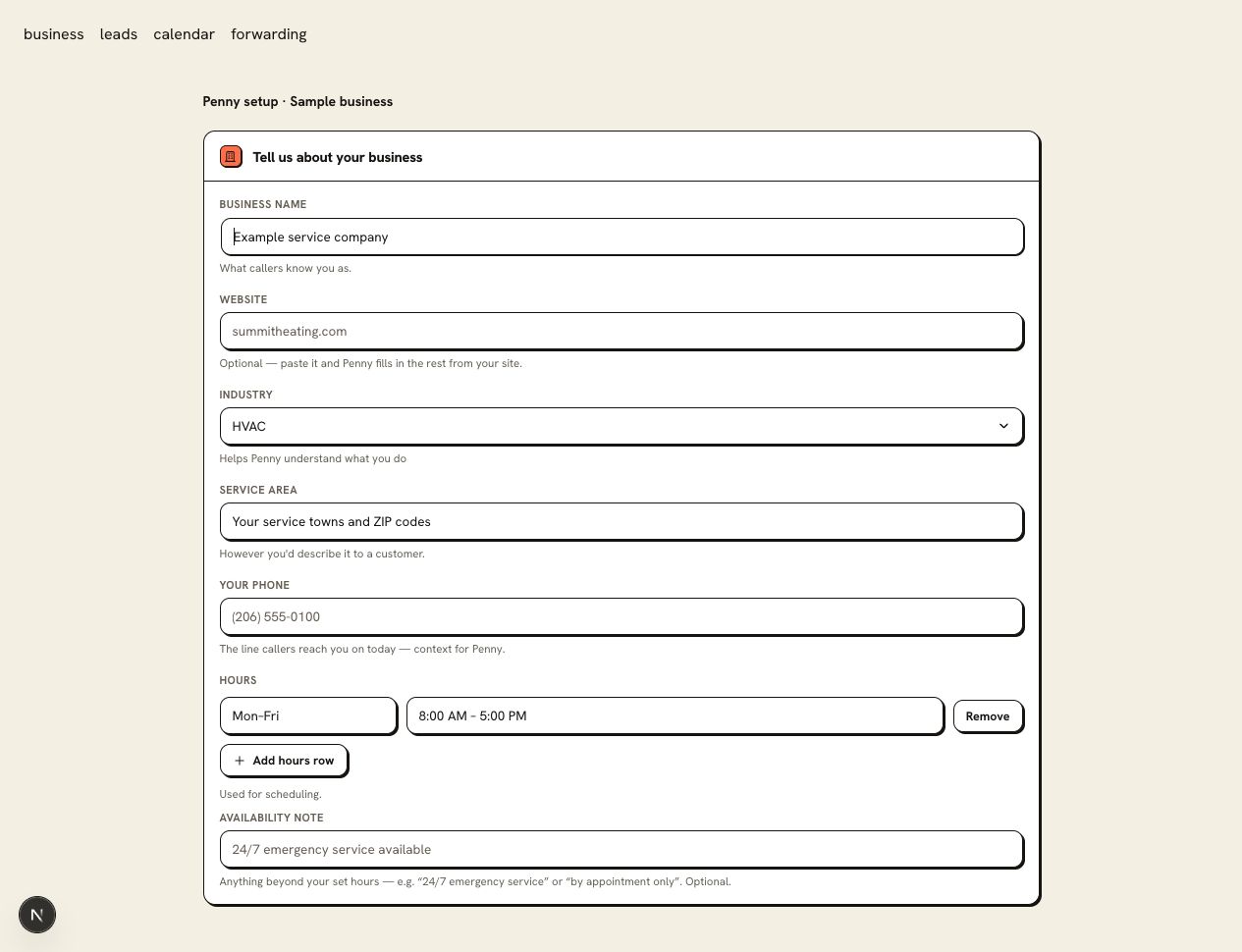
Your website supplies the answers specific to your business
Paste your website URL in Knowledge. Penny reads your services, business hours, service area, and published FAQs. Review the result against what your office tells customers.
A trade reference can explain what a tune-up is. Your website tells Penny whether your shop offers one and which towns you serve. Enter business-specific prices and policies in your settings when you want her to quote them.
03
Resolve conflicting answers before the next customer asks
Compare the imported pages with your current business settings. An old promotion, a location you no longer serve, or a service you stopped offering can give Penny the wrong local detail even when the trade explanation is correct.
Remove or correct the outdated source, update the saved business facts, and ask the same question again. Check the answer in both the chat log and a test call if you use phone answering. Keep the accepted answer with your office procedure so the next person reviewing the account can repeat the check.
04
Refresh the reference as your services change
When you update a service page or change your hours, re-read the website in Knowledge. Check the result, then test the question a customer would ask.
Use a concrete test such as ‘Do you service heat pumps in my ZIP code?’ Confirm the service-area answer against your saved coverage. A test tied to your own business finds gaps that a general conversation can miss.
Match Penny’s answers to the work your shop accepts
Send setup or plan questions to support@pennyassistant.com.
No. Enter your services, hours, service area, and approved policies during setup. A website saves you retyping those details. Add or refresh it once its pages reflect the work your shop takes.
Give Penny a call before you forward yours.
Try the HVAC demo, then set up Penny for your business. Your account includes 14 days of Pro; Free keeps your website chat after the trial.
14 days of Pro included. No credit card.